
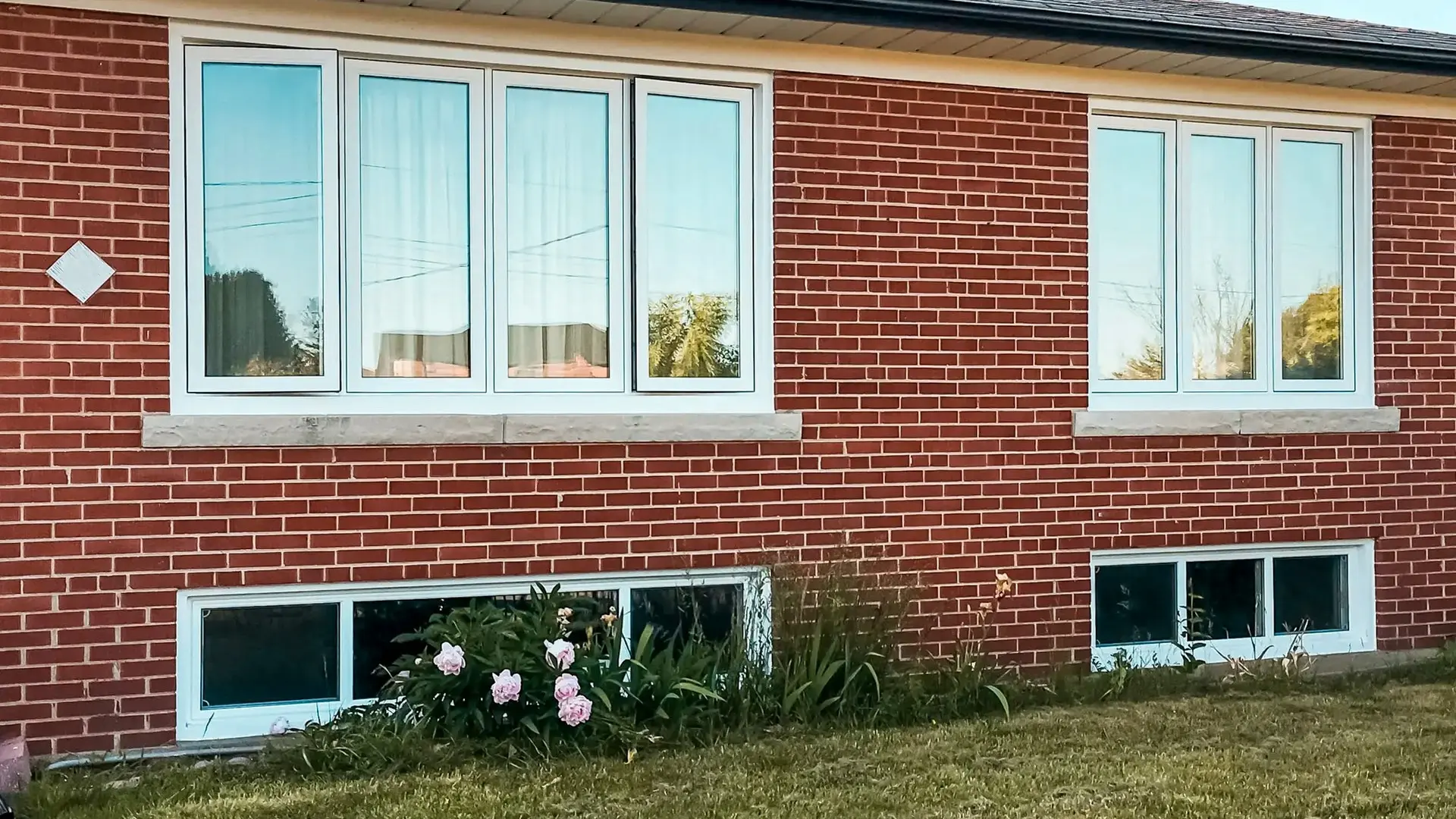
In many South Shore bungalows and split-level homes, basement windows receive little attention until the space becomes a family room, home office, or bedroom. That is often when homeowners begin noticing limited natural light, cold air near the opening, or a sash that is difficult to operate.
A basement window replacement in Châteauguay should begin with the room’s intended use and the condition of the entire opening. The window well, drainage, ventilation, rough opening, and applicable egress requirements can all affect the final choice.
Why Basement Windows Require a Different Approach
A basement window sits closer to ground level than windows on the main floor. Depending on the property, snow, rainwater, ground moisture, and freeze-thaw cycles may affect the area around the opening.
Basements can also have higher indoor humidity. When warm, humid air reaches cold glass, condensation may form on the interior surface. This does not automatically mean that the window needs to be replaced.
Condensation between the panes usually points to a problem with the sealed glass unit. Water marks around the frame may instead be related to the window well, drainage, grading, or the surrounding foundation. A new window may improve comfort, but it will not necessarily correct a problem originating outside the window assembly.
Match the Window Style to the Window Well
The operating style matters more in a basement because exterior clearance is often limited. A window may look suitable on paper but become impractical if the sash cannot open freely inside the window well.
A slider is common in horizontal basement openings. It does not project outward, which makes it practical where exterior clearance is tight. However, only part of the total window area opens, so the clear opening can be smaller than expected.
An awning window opens outward from the bottom. It can provide useful ventilation, but the window well must be deep and wide enough for the sash to move without obstruction.
A casement window can offer a larger clear opening and good air tightness when properly installed. It also requires enough space outside for the sash to open fully.
A fixed window can bring in natural light, but it provides no ventilation and cannot serve as an emergency exit. It is therefore unsuitable for certain rooms and applications.
Before selecting a configuration, homeowners can compare general window replacement options and consider how each operating style fits the actual opening.
A Basement Bedroom Changes the Priorities
When the room is used as a bedroom, the window may need to serve as a means of egress. The fact that a window opens does not automatically make it an egress window.
The clear opening, accessibility, operating method, and exterior conditions all matter. For example, a slider may have a reasonably large frame while providing a much smaller unobstructed opening once the sash is open.
Requirements can depend on the building, the work being completed, and the rules that apply to the property. The Régie du bâtiment du Québec provides a starting point for Quebec building and safety requirements. The applicable requirements should be confirmed before ordering the window or changing the foundation opening.
Enlarging an opening in a foundation is also more complex than replacing a window within the existing dimensions. It may involve masonry, structural considerations, a different window well, and additional compliance requirements.
What a Window Assessment Should Examine
A proper assessment should look beyond the width and height of the existing frame. Important points include:
- Dimensions of the window and rough opening
- Condition of the frame, sill, and surrounding materials
- Available clearance inside the window well
- Grading and water movement near the foundation
- Interior condensation or moisture signs
- Current or planned use of the room
- Interior and exterior finishing requirements
- Whether a full-frame replacement is appropriate
This helps prevent a common mistake: choosing a high-performance window without considering how it will be integrated into the opening. Installation quality varies, and even a good product can underperform if the measurements, insulation, air sealing, or exterior finishing are inadequate.
Double or Triple Glazing for a Basement
Triple glazing can provide better thermal performance, but it is not automatically necessary for every basement window. The practical benefit depends on the glass area, exposure, condition of the existing unit, and how regularly the basement is occupied.
A well-selected double-glazed window may be sufficient for many smaller openings. Triple glazing may be worth considering for larger windows or frequently used living spaces, but the added cost should be compared with the expected improvement.
Paying for every available upgrade rarely makes sense. The frame, glass package, dimensions, and installation should be evaluated together.
Budget and Project Timing
The cost of basement window replacement in Châteauguay depends on the dimensions, operating style, glazing, frame condition, access, and finishing work. A standard replacement within the existing rough opening is generally simpler than a custom unit or an enlarged foundation opening.
A narrow window well, nearby landscaping, or a finished interior can add complexity. If the basement is being renovated, it is usually better to assess the windows before closing or refinishing the walls.
Exterior work around a window well may also be harder when the ground is frozen or covered by snow. Scheduling should reflect the complete scope of the project rather than the window alone.
Look at the Complete Opening
The right basement window is not necessarily the most expensive model or the one with the longest list of upgrades. It needs to suit the room, the available opening, the window well, and the conditions around the foundation.
For homeowners in Châteauguay and nearby South Shore communities, Fortena can evaluate a planned basement window replacement in the context of the complete opening. This helps separate window-related concerns from issues involving humidity, drainage, or the surrounding foundation.
Frequently Asked Questions
What type of window is best for a basement?
It depends on the opening, window well, and room use. A slider works well where exterior space is limited, while a casement may provide a larger clear opening when enough clearance is available.
Is triple glazing worth it in a basement?
Not always. It can improve thermal performance, but the benefit depends on the window size, exposure, and how the room is used.
Will a new basement window eliminate condensation?
Not necessarily. Interior condensation may result from high humidity or limited ventilation. The location and likely cause should be identified first.
Does any opening basement window qualify as an egress window?
No. The clear opening, dimensions, accessibility, and exterior configuration must meet the requirements that apply to the property.